



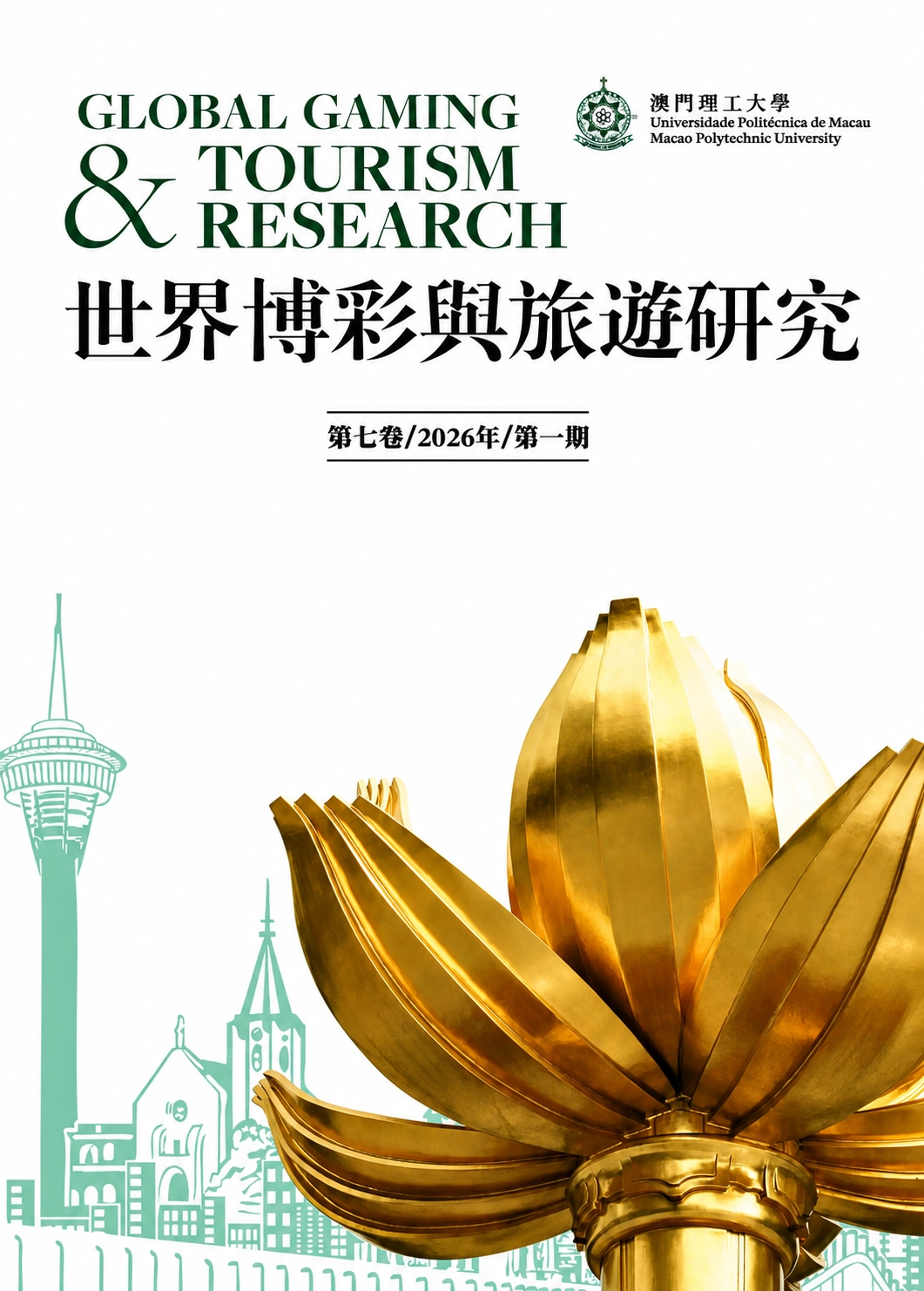
Estudos na Área do Jogo e do Turismo Mundial
.png)
|
ISSN: |
ISSN 2707-7438 eISSN 2707-7446 |
|---|---|
|
Period: |
Semi-annually |
|
Introduction: |
“Global Gaming & Tourism Research” aims to promote the sustainable development of the gaming and tourism industry. In addition to providing support for science-based decision-making across the public and gaming sectors, this academic journal seeks to serve as an exchange platform for gaming and tourism research work. “Global Gaming & Tourism Research” covers such key areas as the development trend of the Macao and global gaming industries, evolution and trend of consumer preference among gaming tourists, responsible gaming theory and practice, tourist behaviour theory and case studies, and tourist destination management theory and practice, etc. Contributions by experts, scholars and industry practitioners are welcome. |
|
|
|
Three-Dimensional Risk Assessment of Gambling Harm in Minority Cultural Groups:A Four-Country Comparative Analysis
Abstract: This study proposes a three -dimensional risk framework—structural exposure, cultural interpretation, and institutional uptake—to analyse how gambling risks for minority groups are produced and governed in multicultural societies.Using this framework, the article compares policy documents, official reports, and academic research from Australia, New Zealand, the United Kingdom, and Canada(Ontario).It examines cross-national differences in exposure environments, cultural interpretations, and institutional uptake capacity, identifies how these dimensions interact, outlines each country’s governance model, and highlights their respective strengths and ongoing challenges.The analysis shows that the core issue in minority gambling harm is not “higher participation” or “greater vulnerability”, but the fact that the three-dimensional chain breaks: structural exposure is uneven;institutional responses often overlook cultural interpretations;and institutional uptake is constrained by state/provincial autonomy or platform-driven governance logics, reducing the visibility of harm.In comparison, New Zealand maintains a relatively coherent three-dimensional governance chain;Australia and Canada(Ontario)exhibit fragmented structures;and the UK relies on platform-side identification to enable early intervention.The framework helps revealing how risks are translated through cultural meaning in contexts of structural exposure, and how institutions ultimately choose to absorb or exclude them.The study concludes that improving minority gambling data, enhancing cultural understanding, institutionalising cultural adaptability, and strengthening cross -platform regulation are critical directions for future risk governance.
|
Li Bingqin |
|
Study on the Development of the Gaming Industry in the Process of Appropriate Economic Diversification in Macau
Abstract: Since the opening of the gaming concession system in 2002, Macau’s gaming industry has experienced rapid development, driving the construction of local integrated tourism resorts and demonstrating a positive role in the region’s economic growth. However, the long-established “overwhelming dominance of a single industry” structure has rendered Macau’s economy highly sensitive to external shocks, while the potential risks and problems inherent in the gaming industry remain unresolved. This paper takes 2002—the year the gaming concession was opened—as its starting point, analyzing the gaming industry within the context of Macau’s gradual pursuit of appropriate economic diversification. It aims to explore the evolution of the gaming industry throughout the advancement of this diversification strategy, objectively assesses its role in economic growth and social development, and analyzes the structural potential risks arising from long-term reliance on the gaming industry. The findings reveal that while the gaming and tourism sector has played an undeniable role in promoting Macau’s economic growth, fiscal accumulation, and urban development, it has also led to deep path dependency in fiscal revenue, labor structure, and the industrial ecosystem. Furthermore, it has generated potential threats to national financial security, particularly in relation to cross-border capital flows. Currently, Macau’s gaming industry faces challenges such as slowing growth, structural transformation, intensifying external competition, and internal resource constraints. In the future, the “1+4” industrial strategy should be adopted as a key lever to strengthen the driving function of the leisure tourism sector: improving the gaming industry regulatory system, addressing structural talent shortages, deepening regional cooperation, and building a diversified industry-driven development landscape.
|
Zhong Yun, |
|
Business Model of VIP Gaming Industry in Macao Transformation Challenges and Development Suggestions
Abstract: The gaming industry plays an exceptionally important role in the socio - economic development of Macao, with the VIP gaming sector being a crucial component. However, academic research specifically focusing on VIP gaming industry in Macao remains relatively limited. In recent years, the sector has undergone unprecedented transformations. Based on a review of the evolution of the gaming and VIP business models in Macao, this paper analyzes the current challenges faced by the VIP gaming industry and the underlying influencing factors. It further proposes strategic recommendations for its future development. The aim of this study is to contribute theoretical and practical insights for the sustainable development of VIP gaming industry in Macao and to provide references for reshaping the competitiveness of gaming sector in Macao in the future.
|
Li Qiang, |
|
The Genealogy of the Gambler’s Image and Ethical Narratives in Macau Thematic Literature
Abstract:The gaming industry has shaped Macao’ s distinctive urban culture and has also become a central focus of literary narratives. This study examines the representations of gamblers in Macao thematic literature, deconstructing the capital myth behind the prosperity of the “casino city”. Four representative Macao novels ( 2007-2016) are selected and analyzed through text - coding with NVivo to explore how literature constructs gamblers as prisoners of space, thereby exposing the structural violence imposed by capital logic on individuals and society. The article innovatively adopts a space-ethics dual - axis analytical framework, and finds that while literary narratives succeed in critiquing the capital myth, the recurrent paradigm of individual redemption(especially maternal redemption) objectively obscures the structural absence of social responsibility. Ethical dilemmas are thus redirected toward individualized and gendered sacrifice, producing a sharp contrast with policy shortcomings in reality. This research not only fills a gap in the typological study of gambling- related literary figures but also provides a new academic perspective and pathway for reconstructing gambling ethics governance through narrative intervention.
|
Li Sirui, |
|
Research on the Spatial Dependence of China Sports Lottery Sales: Based on the Spatial Durbin Model
Abstract:Based on the theoretical framework of spatial econometrics, this study systematically investigates the spatial dependence of per capita sports lottery sales and its formation mechanisms across Chinese provinces using provincial panel data from 2000 to 2024. The aim is to uncover the spatial distribution patterns of China's sports lottery market and to determine whether the spatial interaction mechanism is characterized by synergistic spillovers or competitive siphoning. First, exploratory spatial data analysis (ESDA) confirms significant positive spatial autocorrelation in per capita sales before 2016, presenting significant “high-high” and “low-low” clustering patterns. However, this spatial structure weakened notably thereafter. Subsequently, a Spatial Durbin Model (SDM) is constructed for empirical analysis. The results indicate robust positive spatial spillover effects in provincial sports lottery sales. Further effect decomposition reveals that per capita GDP growth exhibits a “synergistic growth” pattern, urbanization displays a “competitive diversion” pattern, and the aging rate demonstrates a unique “structural substitution” pattern. Robustness checks and regional heterogeneity analysis further show that these spatial spillover effects and their driving factors differ significantly across eastern, central, and western regions, exhibiting asymmetric characteristics such as a U-shaped distribution. The main contribution of this paper is that it applies the SDM to research on China’s sports lottery sales, clearly identifies multiple spatial spillover mechanisms and their regional heterogeneity, and provides a scientific empirical basis for formulating differentiated and coordinated regional lottery market policies.
|
Li Gang, |
|
|
|
Love for the Unvisited Destination: Concept, Formation Mechanism, and Consequences of Potential Tourists’ Destination Brand Love
Abstract: Destination brand love (DBL) is a critical source of competitive advantage. The proliferation of digital media has profoundly shifted how tourists form emotional attachments to destinations. However, prior research is predominantly anchored in an experience-satisfaction paradigm, largely overlooking potential tourists who develop a “love for the unvisited” in a state of physical absence. Adopting a grounded theory approach, this study analyzes self-reported reflective narratives from Master of Tourism Administration (MTA) students by systematically decoding the concept, mechanisms, and consequences of potential tourists' DBL. Findings reveal that: (1) this DBL is characterized by high intensity, reciprocity, dynamism, indirect experientiality, and extreme idealization; (2) driven by distinct psychological motives, it manifests in four typologies: mirror-compensatory, relational attachment, aspirational-advancement, and totemic identification; (3) it dynamically evolves through a path of “motive matching—internalized processing—relationship consolidation—evolutionary divergence”; and (4) it yields a “reciprocal empowerment” effect, simultaneously enhancing destination relationship resilience and replenishing tourists' psychological capital. This study expands the conceptual boundaries of DBL beyond physical experience, elucidates the underlying mechanisms of its dynamic evolution, and broadens the scope of DBL consequences by highlighting its psychological benefits for tourists themselves. The insights offer practical guidance for destination management organizations in implementing pre-experience marketing and expectation management.
|
Zhang Hui, |
|
Love and Conflict: A Study on the Mechanism of Romantic Conflict Affecting the Future Travel Intention of Tourist Destinations
Abstract: This study examines the management of conflicts and their subsequent impacts within the high-intensity interactive context of romantic tourism, from a dynamic relationship perspective. While travel is often viewed as an opportunity to strengthen relationships, travel-related conflict can become a “relationship stressor”, with effects extending to post-trip behavioral intentions. Currently, the specific impact of conflict on couples’ willingness to revisit a destination remains unclear. To address this gap, the study proposes that conflict influences future travel intentions through two pathways: first, the emotional evaluation pathway, where unpleasant feelings triggered by conflict directly reduce future travel intentions; and second, the relationship security pathway, where conflict induces attachment anxiety to the current specific partner, thereby weakening future travel intentions. The study also hypothesizes that an individual’s neuroticism traits amplify these pathways. Analysis of paired data from 417 Chinese samples, using structural equation modeling(SEM), supports these hypotheses. Conflict indirectly reduces future travel intentions through the dual mediation of emotion and relationship security, with neuroticism positively moderating this mediating effect. This study reveals the emotional and cognitive dual-pathway mechanism by which tourism conflict influences future behavior and clarifies the moderating role of personality traits. Practically, it is recommended that tourism operators pay attention to the dynamics of romantic relationships and provide a paradigm shift path for the tourism industry to effectively manage and empower this unique “relationship-process-based consumption”.
|
Li Xia , |
|
Research on the Development Strategy of Hiking Tourism in Yunnan
Abstract: Hiking is a low-cost, low-barrier form of physical activity that offers unique physical and mental benefits not typically found in indoor exercise. For local governments, hiking tourism represents a low-investment, highly effective, and sustainable tourism product, holding significant value for rural economic development. However, there is insufficient awareness in China regarding the health benefits and economic potential of hiking tourism, and relevant research literature remains scarce. This study systematically reviews international empirical evidence on hiking motivations and health benefits, and for the first time proposes a “Health Evidence-Based Hiking Tourism Development Strategy Framework” (HEHTS Framework), localizing international knowledge to the Chinese context. Based on this framework and leveraging Yunnan’s rich geological, climatic, and forest resources, the study puts forward five development strategies: positioning health tourism as the primary target market, focusing on experience as the core service, promoting differentiated routes for different tourist segments, prioritizing the development of the over-60 age group, and improving trail infrastructure. The academic contribution of this study lies in filling the research gap on the health value of hiking tourism in China and providing a knowledge translation pathway from international evidence to local strategy. Its practical contribution is offering a scientific basis and actionable strategic guidance for the development of hiking tourism in Yunnan and other regions across China.
|
Zeng Jia , |
|
Research on the Tourism Aesthetics of Ancient Chinese Literati and Its Enlightenment
Abstract: Taking the landscape travel works of ancient Chinese literati as the research subject, this paper explores the different modes of their travel aesthetics and the enlightenment they bring to modern tourism. The travel aesthetics of ancient Chinese literati encompasses three major forms: adventurous travel featuring mountain climbing and ridge crossing, in-depth immersive healing travel, and experience-focused cultural travel. This revelation suggests that the modern tourism industry should continuously expand the boundaries of tourism and provide differentiated tourism products tailored to the needs of groups with different ages, occupations, and mental states. Furthermore, the tourism industry ought to deeply excavate cultural resources in various regions and adopt diverse approaches to enable tourists to "perceive history" and "touch legends" through the scenery. The "slow travel" mode practiced by ancient literati also enlightens the modern tourism industry to design long-cycle and in-depth experience customized routes, so as to achieve the goal of “travel as spiritual practice”.
|
Liu Xiangyu, |
|
|
|
|
|
|
|
|